
The Structural Divergence of the 2026 Meta
When the LEC Spring 2026 season kicked off, the meta shifted toward a heavy emphasis on lane-priority skirmishing, a departure from the scaling-heavy compositions that dominated the previous year. Karmine Corp (KC) entered Week 5 with a 6-4 record, relying heavily on high-variance early game plays that often left their late-game objective control exposed. In contrast, Fnatic arrived with a 7-3 record, maintaining a gold-per-minute (GPM) differential of +420, the highest in the league at the time.
The clash on Day 3 was not merely a battle of mechanical skill but a fundamental disagreement on how to win the map. KC prioritized the 'Blue-Side Flex' draft strategy, often sacrificing top-lane counter-picks to secure high-impact jungle pairings. Fnatic, conversely, utilized a rigid 'Red-Side Response' protocol, focusing on neutralizing the enemy jungler through vision control and deep-warding patterns that forced KC into predictable pathing.
This tactical friction highlights the ongoing evolution of professional League of Legends, where the Incap Legends Returns: The Resurgence of Grassroots Esports movement has begun to influence how academy-to-pro transitions are handled. Teams are no longer just drafting for individual comfort; they are drafting for specific, time-gated power spikes that define the 15-to-25-minute window of the game.
SPONSORED

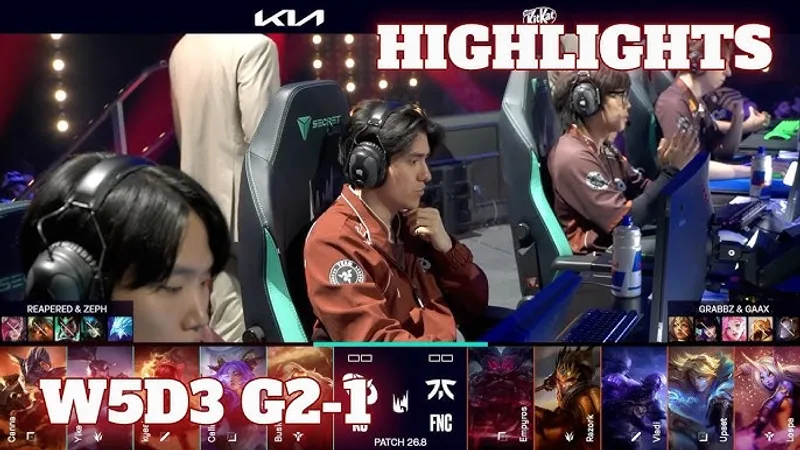
The draft phase for this specific match saw KC ban out the meta-defining support picks, effectively forcing Fnatic into a secondary support pool. However, Fnatic’s ability to pivot into a double-AD carry composition—utilizing a mid-lane Tristana and a bot-lane Varus—allowed them to maintain long-range poke pressure that KC’s melee-heavy composition struggled to engage against.
Drafting Dynamics and the Jungle-Support Synergy
In the Week 5 Day 3 encounter, Karmine Corp’s drafting philosophy centered on the 'Aggressive Reset' archetype. By picking champions like Viego and Pyke, they sought to snowball the early game through reset-based team fighting. According to internal LEC data, KC’s win rate drops by 22% when they fail to secure the first two dragons of the game, a statistic that Fnatic exploited by prioritizing bottom-side river control from the 4-minute mark.
Fnatic’s response was a masterclass in defensive drafting. By selecting Braum and Maokai, they created a 'Peel-and-Lockdown' wall that rendered KC’s engage attempts ineffective. The Maokai pick, in particular, provided constant vision through saplings, effectively neutralizing the fog-of-war advantage that KC usually relies upon to set up their flanks.
The synergy between Fnatic’s jungler and support was the deciding factor in the mid-game transition. By maintaining a 65% ward-clearing efficiency in the enemy jungle, Fnatic forced KC’s jungler into sub-optimal pathing. This led to a gold deficit of 1,800 by the 12-minute mark, a gap that proved insurmountable given the scaling nature of Fnatic’s composition.
Mid-Game Macro: The Breakdown of the 20-Minute Objective
The 20-minute mark serves as the primary inflection point in modern LEC play. During this match, the game state was defined by the 'Baron Bait' sequence. KC attempted a high-risk Baron take to force a fight, but their lack of vision around the pit allowed Fnatic to collapse from the flank, securing a clean ace without losing a single member.
This failure by KC illustrates a recurring issue in their 2026 campaign: the lack of a secondary shot-caller during high-pressure objective contests. While their primary mid-laner possesses elite mechanical prowess, the decision to commit to the Baron without clearing the surrounding vision was a fundamental error in macro-management. Fnatic’s discipline in waiting for the Baron to drop to 4,000 HP before engaging ensured they could secure the objective and the kills simultaneously.
Furthermore, the itemization choices during this phase were telling. KC’s top-laner opted for a pure damage build on a champion that required durability to survive the initial burst of the team fight. Fnatic’s itemization, focused on armor penetration and anti-shield mechanics, allowed them to shred through KC’s frontline in under four seconds during the final team fight at the Elder Dragon.
Data-Driven Performance Metrics
The Gold Differential Analysis
The gold differential at 15 minutes remains the most reliable predictor of match outcomes in the LEC. In this specific match, Fnatic held a 2,100 gold lead, which translated into a 78% win probability according to real-time predictive models used by broadcast analysts. KC’s inability to find a pick-off in the side lanes meant they could never claw back the deficit.
Champion Pool Versatility
Fnatic’s ability to flex their mid-laner into three different roles during the draft phase forced KC to burn their bans on non-priority targets. This 'Draft Tax' is a common strategy used by top-tier teams to limit the opponent's options. KC’s reliance on a narrow pool of comfort picks ultimately limited their ability to adapt once the game moved into the late-game phase.
Vision Score and Control
Fnatic finished the match with a total vision score of 142, compared to KC’s 98. This disparity was most evident in the mid-game, where Fnatic’s support player utilized deep wards to track the enemy jungler’s movement across the entire map. This level of control is what separates the top-four teams from the rest of the LEC table, as it allows for proactive rather than reactive play.
Future Implications for the LEC Spring 2026 Season
Looking ahead, Karmine Corp must address their reliance on early-game volatility if they hope to secure a playoff seed. The league is becoming increasingly efficient at punishing teams that cannot play a controlled, scaling game. If KC continues to force plays in neutral territory without vision, they will likely struggle against the top-tier tactical squads like Fnatic and G2 Esports.
Fnatic, on the other hand, has solidified their position as a title contender. Their ability to execute a disciplined game plan, regardless of the early-game state, is a hallmark of a championship-caliber team. Their focus on objective-based macro rather than individual highlight plays is a trend that will likely define the remainder of the 2026 season.
As the LEC continues to evolve, the gap between teams that rely on raw talent and those that prioritize structural discipline will only widen. The Week 5 Day 3 match between these two organizations serves as a case study for the importance of macro-cohesion. For fans and analysts alike, the remainder of the season promises to be a test of which teams can adapt to this increasingly analytical approach to professional play.
FAQ
What was the primary reason for Karmine Corp's loss against Fnatic in Week 5?
Karmine Corp lost primarily due to poor vision control and a lack of secondary shot-calling during high-pressure objective contests. Their 98 vision score compared to Fnatic's 142 allowed Fnatic to dictate the pace of the mid-game.
How did Fnatic's draft strategy neutralize Karmine Corp?
Fnatic utilized a 'Peel-and-Lockdown' composition with Maokai and Braum, which effectively countered KC's melee-heavy, reset-based team fighting. This forced KC into sub-optimal engagement windows.
What is the significance of the 20-minute mark in the LEC Spring 2026 meta?
The 20-minute mark is the primary inflection point where objective control and gold leads solidify into win conditions. Teams with a gold lead at this stage currently hold a win probability exceeding 75%.
How does the 'Draft Tax' strategy work in the current LEC season?
The 'Draft Tax' involves flexing mid-lane or support picks across multiple roles to force the opponent to waste bans. Fnatic successfully used this to limit KC's access to their preferred comfort picks.
